Nuclear Option-the game, not the parliamentary procedure
This is perhaps a post that has no real answer, no real solution, but it’s an issue that sprung at me with such ferocity, was suppressed just as quickly, and now lurks every time I boot up a new game–but most specifically Nuclear Option.
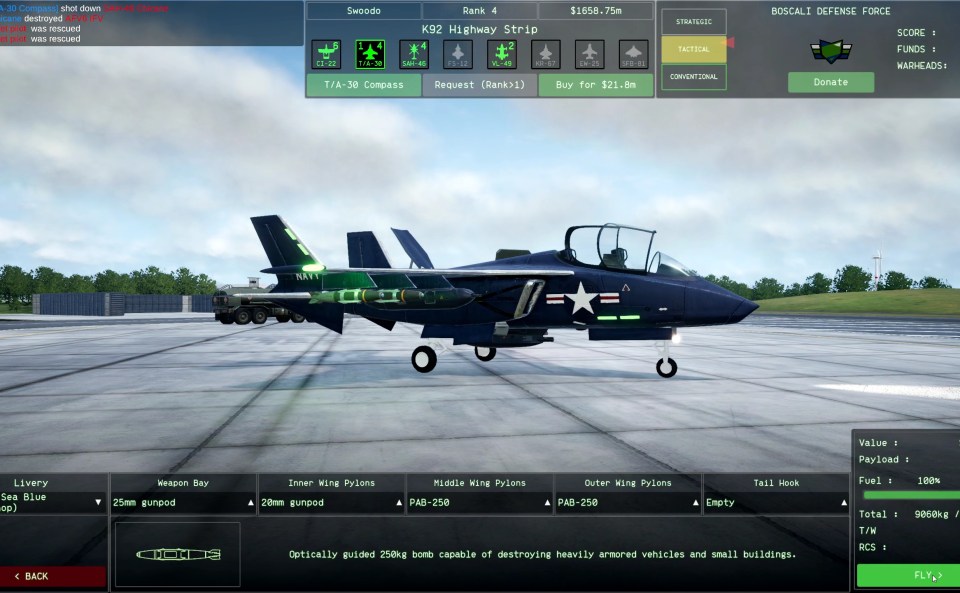
A friend introduced me to the game, got me hooked on the early access flight sim-lite that bills itself on it’s Steam page as a game where one can:
“Fly near-future aircraft with immersive physics on intense battlefields, facing land, air and sea threats. Wage war against AI or other players with an array of potent weapons. Wield tactical and strategic nuclear weapons, capable of annihilating anything in their path.”
In essence, what it boils down to is flying around, targeting red squares or red triangles, evading missiles fired at you, and trying to remove more of the red from your map than they do of your blue icons. It’s essentially “War of Attrition: The Game”, at least in the way that my friend and I play it. And said war can be as large or as small as one wants with sessions lasting anywhere between twenty minutes to several hours.
As he and I were playing the other day and I had just fired off a couple of missiles to take out some enemy tanks encroaching on our base, the thought struck me–“what was the point?”
I understood what the game expected of me and the way that the simulation of this battle was going to play out, but for me, the player, why was I doing this? What was driving me to sit in front of this screen, click, and watch red icons disappear?
I hummed and hawed about the question but really could not come to terms with what provoked me so about that question, the way that it seemed to soon invade every game I booted up. I could not stop thinking about what my purpose was in playing these games–call it a crisis of faith or what have you–I was in the midst of a trouble.
After a while, thinking about the question, about what the point was in playing these games–any of them–it led to a question deeper than just what the point was.
Really the main question was:
What do we want from video games?
Quick Authors Note: Hi. Hello, it’s me. Originally this was going to be a much larger question on the thought of “what do we want from art” but for the sake of brevity I will contain it to just video games in this instance. That larger idea may or may not pop up later on down the road on this blog depending on how I feel about writing it all out.
Not even in the sense of what do we want from art and video games emotionally, but what do we want from it within our lives? So much of playing video games is labeled as “wasted time,” and often I can fall into that trap as well, thinking of it as a Sisyphean task that I derive some bit of joy from.
That’s a cynical take, for sure, but it’s a take that is shaped by the idea of productivity, a modern, post-industrial thought that equates a persons worth to how much they can output in a lifetime, how much product they can deliver for people to consume (much like this blog!). It’s a thought process that’s all too easy to fall into when thinking about how to spend ones time.
So do we want to feel productive when taking in art? Do we want to feel like we’ve accomplished something? These games are very good at that. In Nuclear Option, I feel that I’ve accomplished a great rout, I’ve vanquished some foe with a friend while under incredibly adverse situations.
It’s all progress, just a different kind.
And now: A Red Dead Redemption Interlude

Last week I spent seventeen hours playing Red Dead Redemption II. It’s a game I can’t seem to shake as of late and something about it that’s especially gripped me is its pacing.
The game spends a good couple of hours introducing you to the game, its systems, the world, etc. The first chapter is long, and even once you are into the second chapter, the game never rushes you to move faster. There’s no time crunch or imminent peril.
As a result I’ve spent a great number of those seventeen hours–a majority of them, I’d say–just hunting and exploring the wild west world that Red Dead II opens up to the player. I’ve spent hours upon hours hunting legendary animals and other non-legendary animals, all to get the right furs for the correct satchels and clothing options in the game. And I feel no need to move on. The game, for me, has become a hunting simulator (with the occasional wild west gang shootout thrown in for some variety), Arthur Morgan my gruff mountain man avatar I’ve enlisted to kill and skin and haul and sell all the animal entrails.
I’ve spent time in the game sitting by a stream and watching animals roam in the grassy fields before me, marveling at the simulated coexistence of life. This virtual wild west has been an escape for me during the cold winter months in the East. I’ve read about wars in the Wild West and began reading a book on how cattle farming laws and the expansion of homesteading lead to the decline of free range cattle and the life of the cowboy in general (seriously this is a really great read).

Through it all, it’s never been about completing the game. Sure the percentage that I have completed in the game has gone up as I’ve killed and skinned and studied and explored and fought and helped. But that’s a consequence of my time living in this game.
I spent much of last year worried about how many games I would complete (read this article here). And it’s great to reflect on the games that one has experienced and moved on from. But it’s also just as good to spend time with a game not for completionism sake, not to feel like you’ve been productive, but to just waste time in a different way. Not everything has to be about “making progress” or “being productive” especially in a world that demands those modes from us every other waking minute of our life.
So what’s this all about?
Really it’s just about a thought I’ve had riding on my mind for a while now, about how we engage with video games and with art and how so much of that feels often like it’s based on this idea of being “productive” with our time.
Video games, for me, have never been about that. They’ve been about having fun and being a vehicle to connect with friends, relax, and make some memories. If I end up completing some of them in the process, so be it, but not everything has to be wrapped up solely in how much I’m crossing off my list (hell, I do enough of that in my day job).
Video games are an escape, and I think I’m okay with that. Whether it’s relaxing in the wild west or wiping red polygons off of a map or railing against a games notions of how to try and fail purely for the sake of it, none of it really matters. Which I love! Often times games don’t need to be much more than that. But if they are, then hey, more cake for me–as the saying goes.
Discover more from Stupid Big Thoughts
Subscribe to get the latest posts sent to your email.
 Stupid Big Thoughts