I’ll admit, this article got a little away from me–chalk that up to winter break free time, or a passion for the medium of video games finally releasing from within me and onto the page, or a strong desire to talk about how much I truly loved Cyberpunk 2077–whatever it may be, the result is a 4,100 word essay/mini-review of every game I completed this year. I hope you read it, enjoy it, and that the new year treats you well!
So Get on With it Then!
Okay, fine!
This year more than any other, I’ve really put an effort into completing more single-player video game experiences.
I’ve held a long backlog of games that “I’ll get to someday” on Steam, but this year was going to really be the year I worked to get through a lot of them. So, with all that being said, how did I do?
The TL;DR is: pretty good!
Here are some basic stats for this year:
- Number of games I beat in 2024: 8
- Difference from number of games beat in 2023: +3
- Approximate hours played: 117.6 hours (half of that time being Cyberpunk 2077)
- Average amount of days to beat a game: 217 Days*
- Average rating: 7.5/10
- Favorite story-driven game completed this year: Cyberpunk 2077
- Favorite other releases/non-story-driven games of 2024: Balatro and Helldivers 2
*It should be noted that many of these playthroughs had begun in 2023, hence the lengthy time-to-complete stat
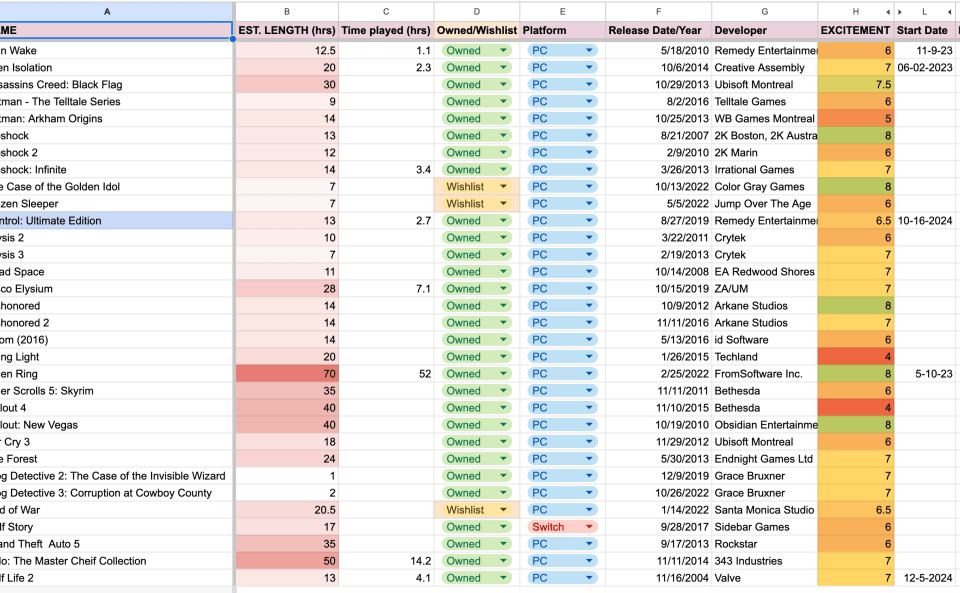
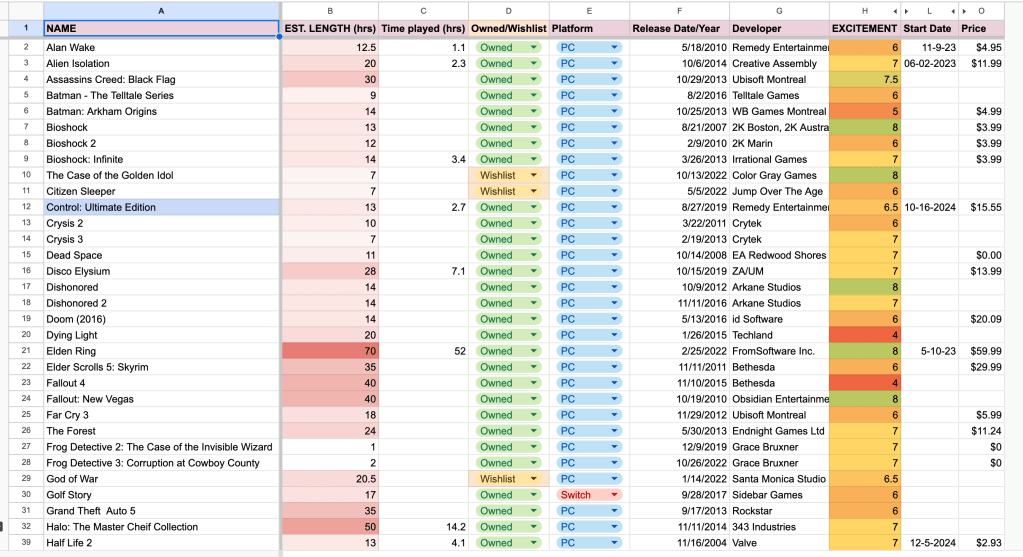
I’m certainly happy that my overall number of completed games this year went up over previous years. I bit off some pretty big games from my backlog this year (or at least big for somebody who prefers their single-player games to come in around or well under the 15 hour mark), and I started and stopped what felt like far too many games. But all in all I’m happy with my “progress” on the backlog and I’ve a lot to look forward to in 2025.
For those that just want the TL;DR, well you’ve just read it, but for those that want more in depth thoughts about each game, feel free to read on.
The First of the Year
I started off the year by finishing up Marvel’s Spiderman Remastered. It was a real treat of a game, melding lovely Arkham-style fighting systems with a really great story. And say what you will about the Mary Jane stealth sections, I thought they never overstayed their welcome and were a nice detour from the regular spidey-swinging gameplay. As I wrote in my notes when I first finished the game:
Tight mechanics and a compelling story make this the best Spiderman game I’ve played and one of the best superhero games I’ve played. I still prefer the Arkham games which I think have a greater variety of gameplay, but this is still great. It flows really well and has a nice snappy feel. With less of an emphasis on stealth though, there’s a little less variety to the gameplay. As such, it became a little old by the 70% mark, but powering through it was worth it for the story moments to follow. Every character is acted superbly well and the ease at which the game juggles all of its characters is really impressive. Near everyone gets their due here and the finale tees up lots of anticipation for the sequel. The story is really solid, and although the sinister six twist is a bit out of nowhere, the finale makes up for it with some really compelling moments. The combination of the wow factor that a tentpole like this game should have with solid gameplay makes for a real winner.
From there, I moved to a small indie game called one night, hot springs. It’s a simple narrative game with multiple endings though I only played through one of them. It came in at around 20 minutes of playtime and though there weren’t too many different choices you could make, it was nice that there were some. As such, it almost plays like a visual novel (really more like a short story) with some slight interactivity. But as it was free to play, I came away enjoying it quite a bit. It was a light, complete-in-one-sitting kind of game and I always feel that those are nice palate refreshes from the bigger and heavier games of the year.
After that I took a pretty long break from single-player games. I was still working through some longer games here and there (most notably Cyberpunk 2077) but, as my Steam recap shows, I got very sucked into Helldivers 2, with it taking up 74% of my play-time in April (yikes)!
Although it’s not a single-player narrative-focused game, it does have an engaging and inventive meta-narrative that is a really nice refresher from the plethora of other multiplayer games of similar ilk. It’s a real highlight for me of 2024 that the game team is able to respond so well to player actions and also to create in-universe “missions” for the thousands of players that dive. From creating a “black hole”, to seeing the horrors of Malevelon Creek, the game has remained inventive and engaging from day one.
So Soon, Summer Break
Although I would like to say that Helldivers 2 does not rule my gaming life anymore, that would be a lie. And through a busy summer filled with travel, into a gloomy fall and winter in Toronto, the middle half of the year went with nary a game completed. There were attempts though. I looked at getting back to my racing roots with a good deal on Need For Speed: Heat but the story failed to captivate in any capacity.
I fell back into modding and playing through Fallout: New Vegas, a game that I’ve owned for close to a decade now and still have not finished. Maybe one day, but this playthrough was not the time. I was entranced by the game though, and loved roaming the wasteland, completing side-quests, and encountering interesting characters. It’s a game that’s wonderfully open and available to take in so many different avenues. I’m sure I’ll come back to it in 2025.
I got sucked into the factory building in Satisfactory when their 1.0 release came out, spending countless hours working away at milestones with friends and building mile after mile of railroads.
I felt the addictive hot streak of Balatro (a strong contender for GOTY for me) and realized that I don’t love Elden Ring as much as I want to love it. And through it all, I kept on playing Cyberpunk 2077.
Cozy Gaming Fall
But before we get there though, I want to talk about The Room. No, not the cult classic movie from 2003, but the puzzle game released by Fireproof Games in 2012.
My first interaction with the game dates back to around the time it was released. I was in middle school, newly bestowed upon with the power that was the iPod Touch, and I was hungry for good games. I bought The Room for a couple of dollars back then and was enamored with its interesting alchemical world. There was a deeper mystery afoot than just the complex and unfolding box that lay virtually in front of me. This was a story of a teacher meddling with powers beyond comprehension and an ignorant student (the player) following in their footsteps. It felt fresh and new and I loved it.
So when I saw the bundle of the first three games for sale on Steam for under $5, I felt I had to grab them, even just for nostalgia’s sake.
In the latter half of this year, puzzle games have really stood out to me as a genre that I can feel myself getting further and further into in 2025, so throwing back to The Room was a blast. All the puzzles felt familiar from all those years ago yet still challenging enough to keep me engaged. It’s a short game, taking just under two hours to complete, but with its interesting narrative and intriguing visual style, it still stands out to me. Though it is essentially a mobile port of the iOS and Android game, it plays really well, with the mouse replacing what would be a finger. I never once had any issues with the game control-wise or hardware support-wise and for what I paid for all three games, I can’t knock it on that front either. It’s short and fairly simple, but good enough to make me want to keep going in the series.
If The Room was a short romp to kick off my fall gaming sessions, then the next game that I dove into was a bit bigger than it (and the only single player game that I beat which was released in 2024).
Warhammer 40K: Space Marine II is a buff and gruff game–just about as far from The Room as one can get. Think Gears of War but set in the Warhammer universe.
Now, I’m no 40k “stan”. I don’t have any of the figurines (if that’s even what you call them) and I rarely play any other 40k games. But I spent some time playing Vermintide 2 with a friend who is especially into 40k and had a good time. So the fact that Space Marine II was promising similar style gameplay but also with a single-player campaign and it was one that you could play through in three-player co-op had me very intrigued. I fought off the urge to preorder it (since we all know not to preorder games) and once it had been released and the first reviews were rolling in, I bit the bullet.
It’s the only game on this list I paid full price for, with it coming in around $90 Canadian dollars. So from a price perspective would I say it was worth it?
Eh… Probably not, all things considered, as much as it pains me to say so. That’s not to say it’s a bad game, it’s just that with the competition as stiff as it was this year for multiplayer-horde-shooter-type games (read: Helldivers 2), Space Marine 2 failed to make inroads into my multiplayer gaming sphere. Additionally, with my usual history of rarely buying games around launch, typically waiting for a sale down the line, I find it harder and harder to justify buying new games when such a lengthy backlog exists. As such, I put around 13 hours into the campaign and then summarily dropped it.
But those 13 hours of campaign were solid, buff gruff, yelling and tearing gameplay. The way that the game and engine handle spectacle through sheer number of enemies on screen (and just off screen) is unlike any other horde-shooter. Space Marine II‘s tech really has the power to make the odds against you and your squad feel truly insurmountable. And though the game includes more than just spectacle, it’s the one aspect of the game that really stands out for me and left a strong impression.
And Now: A Lengthy Detour
I never used to think I was a role-playing game type of gamer (see how I bounced off of Fallout: New Vegas earlier this year). I’ve tried to in the past though. I’ve attempted a play-through of Skyrim many times, Fallout 3 and New Vegas too many times, and even sunk 30-plus hours into The Witcher 3 before leaving Geralt stranded in the Skellige Islands. It’s just never been a genre that I’ve really gelled with despite desiring so deeply to love those games. So often for me, role-playing games feel like jack-of-all-trades games. They are wide and expansive but so often not deep enough to grip me which is part of the why I’ve found myself so often over the years falling in love with games that do one thing really well versus games that do so many things just kind of okay enough.
So when I say that Cyberpunk 2077 might just be one of my favorite games of all time, I mean that with all the weight that it carries. I was pretty sold on the game after the end of act one, experiencing how delicately the narrative weaved through the game with expert set-up and pay-offs (especially moments with Jackie–no spoilers here). The writing immediately felt top notch, refined, and thoughtful. The gunplay was everything that I had hoped so many Fallout games would have been in the past. It was frenetic and snappy, with none of the plastic weightlessness that Bethesda games so often have in their gunplay (I swear I don’t mean to throw too much shade at Bethesda, it’s just the best reference point that I know of). CD Projekt Red really nailed it with that aspect of the game, one of the core tenets of gameplay.
But what really stuck out to me was the gameplay and just how many different ways you could play through the game.
The brilliance of it really hit me when I was early into Act Two and had just taken up one of the random side mission scattered around the map. I was working for the Aldecaldos (a quasi-futuristic version of the Mexican Cartel) assigned to grab some data from a safe house above a bar. I did the usual, casing the joint, marking enemies while staying outside and out of sight, and preparing myself for a big fight. But before I did so, I walked around the building and spotted a couple of windows that I could open on the second floor.
I maneuvered a car underneath, stood on top of it, and slipped into the room adjacent to where I needed to be, all the while avoiding the gaggle of goons on the first floor. From there it was as simple as knocking out a single guard, disabling one camera, grabbing the data, and leaving through the same window I went in through, walking away on the street as if nothing had ever happened. I didn’t need to kill anyone, and nobody ever knew I was there.
The game gave me an objective and told me to solve it however I saw fit. I could have gone in guns blazing, I could have incapacitated them one by one with hacking and cyberware, or I could have snuck in through some other back door, stealthing through in a different way. But the game allowed me to interact with the mission in such a minimal way (all told I was in and out within a couple of minutes) and it didn’t care that I had potentially “shortened” the mission or that I hadn’t seen all the potential content. I had played the game my way and the game had accommodated that playstyle. From then on, I was hooked–if I hadn’t been already.
Then you couple that with a compelling story, wonderful performances, world class visuals, a lovely world to explore, and snappy gunplay, and it all adds up to be a game that is incredibly wide and gloriously deep–the exact combination of ingredients I desire in role playing games.
I could go on further about this game and just how incredible it is, but in the interest of brevity, I’ll end it here since we still have a handful more games to go over. Not to keep bashing on Bethesda, but as I wrote to myself when I first finished the game: “The best way to describe it is that it feels like the game that Bethesda had alway promised to make but never could.”
And moving from one wide and deep game, to another intensely focused. Also in October, I finally beat Wolfenstein II: The New Colossus.
A slight aside: I started playing this game in January of 2023, only just managing to squeeze in the credits before the end of 2024. The rebooted Wolfenstein from 2014 is up there as one of my favorite single player experiences. When I beat it in 2017, I felt that I had never experienced a narrative so compellingly told in an FPS game and I wanted more.
Well, it took me 7 years since to get to the sequel, but I finally did and with the predecessor still somehow feeling fresh in my mind, I took on Wolfenstein II.
Unfortunately, though, Wolfenstein II feels like a significant downgrade from Wolfenstein I in one crucial aspect that deeply affected how I feel towards the game, and that aspect is stealth (okay–and level design but the two kind of go hand in hand here).
I know, it’s a little blasphemous for a brand like Wolfenstein, so built up on running and gunning, to feel like it’s let me down in the stealth option of all places, but the first Wolfenstein, much like in Cyberpunk 2077, respected the ability of choice.
To dig it out a bit more, a key tenement in many of Wolfenstein’s enemy encounters is the presence of a Commander. These are unique enemies, typically one to two a level, who work to control the battlefield. They have next to no armor but they make up for it in being able to signal an alarm and call in an endless steam of reinforcements upon the player until they are defeated.
Wolfenstein I and II handle these enemy types in similar ways, placing them in odd locations near the back of the map or off in some far corner, requiring the player to navigate through many rooms and enemies to get to them.
Where Wolfenstein I differs though, is in the option of stealth. There’s an express incentive within the gameplay to off these commanders as quickly as possible to prevent the alarm from being tripped and for more enemies to be between you and the objective. The solution to dealing with them, most logically, is stealth. Silently sneak through and kill them before doing any real damage to the other enemies? Now you have a finite amount of baddies to deal with and don’t have to worry about more and meaner enemies coming pouring in.
And in Wolfenstein I there were vents and alleys and side routes to take. There were options and the means to take an alternate route that, more often than not, would lead you to these high value targets and allow you to get at them before they could yell in an armada of goose steppers.
Which is why I felt so disappointed in so many of Wolfenstein II’s encounters. So often there would be one single way to get through the level, whether that be a hallway or a large room. Vents and stealthy options were fewer and further between and too often I would have to grit my teeth and struggle through a handful of reinforcement waves before finally ending the shouts of “Alarm!!”.
That’s not to say that the game was a wash though. The narrative felt as engaging as ever. I’m continuously amazed at how the folks at Machine Games can meld B.J. Blazkowicz into a caring and compelling character, all from the original voiceless and agency-less image that he was back in the burgeoning days of the FPS. The character work on display here, played by the ever-sturdy Brian Bloom is great–-especially the side-plot about his relationship with his father.
The sequel has all the elements of the first game, it just feels a little more watered down in areas. It’s a good thing that the first game was so good–this game is built on good bones–but it never quite hit the same highs as the first entry in the rebooted series for me.
To Rest at the End
My final two games of the year were quite the opposite from one another. First, I finished off Tacoma, the second game from Gone Home creators Fullbright. It’s another short, focused, narrative game that plays almost like an interactive play, moving through empty rooms of an abandoned space station and viewing audio recordings of the crew, attempting to figure out what happened to them.
Similar to gone home, you as the player are more so merely a vessel for this narrative to play out, the audience of one for this particular story. There’s nothing that you can do to change or alter it, but the way that it unfolds with intrigue giving way to investment in these holographic figures is really compelling. It often felt like an interactive movie, with myself as the camera, working to get the best angles for the particular discussion happening in front of me.
There’s no deep gameplay mechanics, no intense action, just watching, listening, and investigating all that went down. The story feels particularly prescient now with how much it focuses on the ethics of AI and being wary of exploitative Mega-corporations–-but I hesitate to go further. This game is one you should get on sale and play through it. It took me around two hours to complete and by the end, I was left wanting more. Certainly not all that bad of a desire.
And finally, I played through Hellblade: Senua’s Sacrifice in the waning days of 2024. I’m not too sure what compelled me to download this game–-it’s been in my backlog for quite a while now–-but it was most likely its short runtime that grabbed my attention.
Immediately, I was blown away by the binaural audio. It’s not just a gimmick that the game employs to grab your attention, it serves real narrative and gameplay purposes, with the voices that whisper in your head telling you to dodge and evade, to strike when foes guards are down, and all the while they whisper to you/Senua about how inadequate and pathetic you are. It’s really compelling and a genius way of marrying the narrative to a core gameplay feature.
That said, though the technical aspects of the game are good, the puzzles and combat leave a little more to be desired. Though the game (for me) came in at 6.8 hours, by the end, the puzzles felt in need of a refresh to make things exciting. And while the combat was solid, I had mastered it long before the credits began to roll. I had almost ceased to feel challenged, and while it is a nice mirroring of Senua’s burgeoning self-confidence that the game should instill the same in the player, I was left wanting just a little more.
I’ll avoid spoilers here, as the story is a good one, but there is a moment a little more than halfway through where you get what should feel like a pretty sizable power-up, yet all it amounts to is another combat mechanic that felt near useless as its ability served only to shortcut another ability whos cooldown timer was already quite short.
Senua’s Sacrifice is a good game and its narrative and presentation are the real standout, but I’m not left in want of more of its gameplay. Should I go and take on the sequel, it will most likely not be in an immediate rush. Overall, it was a satisfying yet slightly empty way to end 2024.
So that’s all that I played in 2024! I will admit, I didn’t think I had this many thoughts about the games that I had played this year before I began to write this. It really all just started with the summary at the top, but then one thought led to the next and now here we are, over three thousand words later.
It was a good year for games and gaming but also one where layoffs in an increasingly precipitous industry continued, and though my list may be light on games that were actually released within this calendar year, I find myself continuously enjoying this hobby and the thrill of finding a new favorite game. It feels that repeatedly (with the exception of Cyberpunk 2077) my favorite games are those created by smaller voices, working on more focused projects. So support those smaller indie devs that you can, I highly recommend it.
As for what’s next: I can already feel myself teeing up various games for next year and, if I do hit my goals of more games completed, then this may have to become a bi-yearly thing so as to not cram more words into an already bloated article.
So here’s to 2025, all the good releases that should come from it, and all the old releases to be played and removed from the backlog.
Thank you for reading and see you then!
Discover more from Stupid Big Thoughts
Subscribe to get the latest posts sent to your email.
 Stupid Big Thoughts